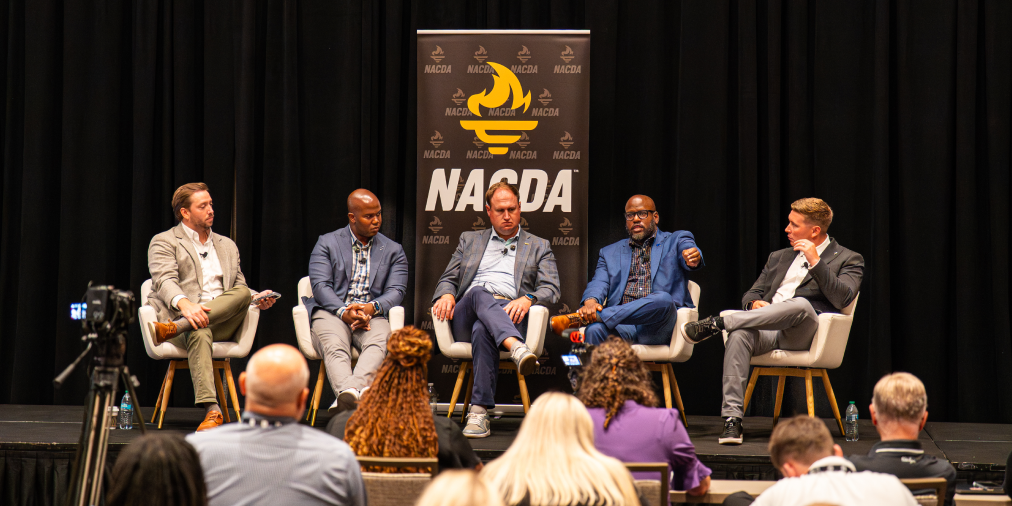
Standing room only. A packed house of athletic directors, administrators, and industry leaders gathered for one conversation: how do college athletic departments build sustainable revenue in a landscape that no longer looks anything like it did five years ago?
The session, "Turning On the Revenue: How Athletic Departments Are Monetizing What They Already Have," was presented by Run Payments and Marsh McLennan Agency and moderated by Ben Portnoy of Sports Business Journal.
NOCAP's Adam Gunn was joined by three practitioners who are actively reshaping what revenue generation looks like inside their programs:
These aren't theorists. They're the people in the rooms making decisions, building partnerships, and figuring out how to reach athletes with real financial opportunity.
The financial pressure facing college athletics is not subtle. Revenue sharing, NIL obligations, and rapidly escalating operating costs are forcing every department in the country to rethink how they generate and sustain revenue. Fundraising alone can no longer carry the load. And waiting on the next media rights deal isn't a strategy.
But here's what the panel made clear: the infrastructure most departments need to build real revenue pathways already exists. It lives inside alumni networks that haven't been fully engaged commercially. It lives inside vendor relationships that haven't been structured for mutual value. It lives inside commercial ecosystems that are sitting dormant, waiting to be activated.
The opportunity isn't about reinventing the wheel. It's about finally turning it.
College athletics is now operating at a financial scale that rivals professional sports. The revenue is there. What's lagged behind is the strategic sophistication to match it. The intentional monetization of existing assets. The creation of structured business networks. The development of revenue pathways that actually reach the athletes and the institutions themselves.
That's the gap NOCAP was built to close. And moments like NACDA – a packed room, a stage shared with leaders from Ohio State, Pitt, and Duke, a conversation that clearly resonated – are proof that the industry is ready for this shift.
A few years ago, we were building in relative obscurity. That's no longer the case.
The conversation at NACDA wasn't a conclusion. It was a starting point. The schools leading on revenue generation today are the ones that will define what a modern athletic department looks like tomorrow. They're not waiting. They're building.