The post-House era doesn't reward programs that wait. It rewards programs that build.
The following universities aren't reacting to financial pressure. They're engineering revenue infrastructure that compounds over time. Real estate. Premium hospitality. Brand partnerships. Stadium overhauls.
The playbook is getting more sophisticated. Here's what's working.
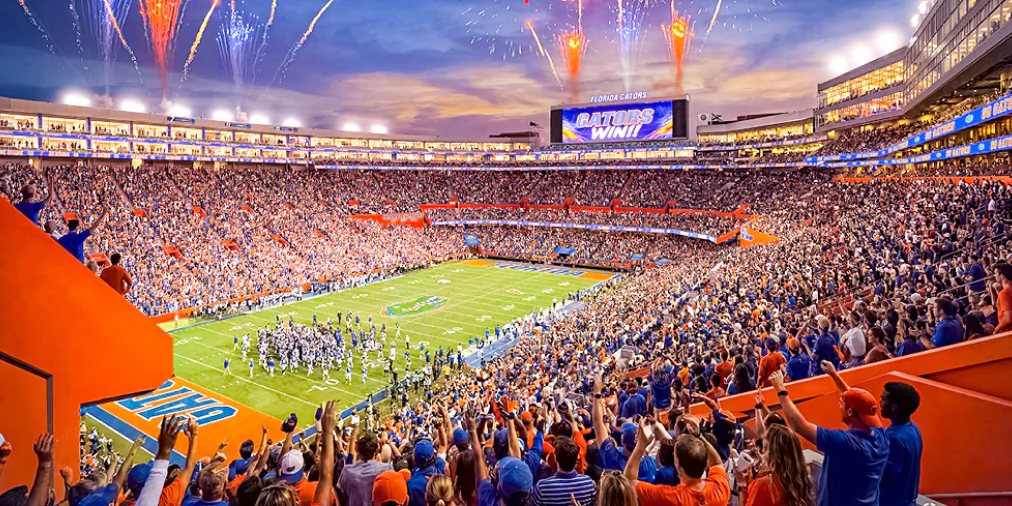
Florida AD Scott Stricklin has a specific way of describing Ben Hill Griffin Stadium. He calls it "a $75 million ATM machine."
The $1.45 billion Ben Hill Griffin Stadium renovation is the most expensive stadium overhaul in college football history. It is built around one explicit goal: nearly doubling that number. Stricklin projects a $65 million annual lift, bringing total stadium revenue to roughly $140 to $150 million by the time the project completes ahead of the 2030 season.
Every decision in the renovation ties back to that target. The current 82 suites get redesigned and 63 new ones get added on top of the east side, all converted from enclosed glass to open air. New premium clubs, lounge seating, party decks, and social spaces get built throughout. Capacity stays at 88,548 – seats lost in the lower bowl to infrastructure and ADA compliance get replaced by premium inventory that generates multiples of what a standard seat produces.
The last time Florida renovated the Swamp was 2003, adding 2,900 club seats and suites. It took them 23 years to come back to the table. This time they studied Fenway Park, Wrigley Field, and Lambeau Field to find the right model and landed on the Packers' approach: keep the lower bowl intact and build premium above it.
Stricklin was direct about the untapped upside: "There are a lot of sponsorship areas that we've never really leveraged. I think we can be really aggressive, and this will generate a lot of excitement, not only among fans but also among businesses that want to figure out how to be a part of it. We can leverage that to not only help pay for the stadium, but we can also leverage that for NIL opportunities." Florida currently sits below most of its SEC peers in the percentage of premium inventory available. That changes in 2030.
The takeaway: A stadium renovation that isn't designed around specific revenue targets isn't a revenue strategy. Florida built this one backwards from $140 million.

Iowa State AD Jamie Pollard looked at 94 acres of underutilized parking lots sitting between Jack Trice Stadium and Hilton Coliseum and made a decision that most ADs wouldn't have the mandate or the patience to execute: he turned them into a real estate business.
CYTown, the $200 million mixed-use development breaking ground with developer Goldenrod Companies in spring 2026 with completion targeted for fall 2027, generates revenue for the athletic department across three distinct and permanent streams.
First, a land lease: tenants pay Iowa State for the right to operate on the property. Second, a PILOT, or payment in lieu of taxes. Because Iowa State is a state institution, it technically owes no property tax on the land, but Pollard structured the development so those payments flow back to athletics anyway. Third, operating revenue from each building based on Iowa State's equity stake, which varies per structure.
In some buildings the split is 50/50 with the developer. In others, 80/20. Every building Iowa State owns outright at completion — Goldenrod builds them, operates them for 30 years, and hands them back.
The development includes a McFarland Clinic anchor already under construction bringing 1,000 new daily visitors to the site, a 215-room hotel and conference center, a 2,800-capacity amphitheater, 72,000 square feet of retail and food and beverage space, luxury residential units, and office space.
CYTown is also structured as a separately trademarked commercial entity with its own naming rights inventory, meaning Learfield's multimedia rights deal doesn't absorb it. It's all new commercial inventory on top of what Iowa State already had.
Pollard's advice for any program considering a similar move: "The more you can make it turnkey for the developer, the better off you're going to be. Do the infrastructure work yourself. Get all the agreements done with the city. Don't make the developer do that."
The takeaway: Most athletic departments are sitting on underutilized land near their venues and treating it as parking. Iowa State turned its parking lots into a permanent commercial asset that will generate revenue for generations. The land was always there. The vision to develop it wasn't.

Army West Point landmark partnership with USAA does three things most brand deals don't.
First, it covers every single one of Army's 30 varsity programs and 1,200 cadet-athletes simultaneously. USAA jersey patches appear across all sports. Most patch deals are sport-specific and tied to football or basketball. This one runs department-wide, giving USAA exposure across every uniform, every venue, and every broadcast, all year long.
Second, it layers in facility naming with "Michie Stadium Preserved by USAA" and 25-yard line logo placement inside one of the most iconic venues in college athletics, connecting the brand to a place with deep emotional resonance for its target audience.
Third, the deal functions as a customer acquisition play rather than a traditional sponsorship. USAA exclusively serves military members, veterans, and their families. Army West Point's cadet-athlete population, coaching staff, and alumni network are among the highest-concentration USAA-eligible audiences anywhere in the country.
The partnership also helps fund the construction of the Athletic Center of Excellence, a next-generation facility for all 1,200 cadet-athletes, and supports the Michie Stadium Preservation Project completing this fall.
AD Tom Theodorakis framed the commercial logic plainly: "As the landscape of college athletics continues to evolve, it is essential that we identify innovative revenue streams that align with our mission and values. This partnership achieves exactly that."
The deal was structured through Learfield's Army West Point Sports Properties. What Army built here is the right model for any program with a defined, identifiable audience – find the brand whose target customer is your fan base, then build the deal around that alignment rather than around logo placement.
The takeaway: The most valuable brand partnerships aren't built around exposure. They're built around audience alignment. USAA didn't buy a patch. They bought direct access to their exact customer base.

Mizzou Athletics is completing two moves at once this fall and the timing is deliberate.
The $250 million renovation of Memorial Stadium to be completed ahead of the 2026 season during the stadium's 100th anniversary year. This adds 2,000 new premium seats including 600 loge boxes, 260 mezzanine club seats, 66 suites, and 14 open-air field-level suites sitting directly under the historic Rock M. The north end zone closure adds 160,500 square feet of new construction, 98,000 of it dedicated to premium experiences.
AD Laird Veatch has been direct about what drives the investment: "The North End Zone is going to have a significant impact on our capacity to generate revenues."
But new inventory without a new hospitality operation is a half-measure. Mizzou recognized that and replaced its entire hospitality program simultaneously, selecting Sodexo Live!, global hospitality partner to some of the world's largest venues. This is a multi-year agreement covering Memorial Stadium, Mizzou Arena, and every Mizzou Athletics venue.
Sodexo Live! is partnering with Columbia-based Upper Crust Food Service to build a locally rooted food and beverage identity into the program. New local food partners, elevated concession offerings, and interactive game day elements designed to make attending a Mizzou event feel like a destination rather than a transaction.
The two moves are engineered to reinforce each other. New premium seating infrastructure generates premium revenue only when the experience around it justifies premium pricing. Mizzou isn't just adding seats. It's building the commercial environment those seats require to retain fans as high-value recurring customers year after year.
The takeaway: Premium infrastructure and premium hospitality are the same investment. Build one without the other and you've left money on the table. Mizzou built both at the same time.
The common thread across these programs isn't the size of their budgets or the age of their facilities. It's a commitment to building commercial assets that generate recurring revenue for years to come.
Whether it's redeveloping real estate, modernizing premium seating, creating strategic brand partnerships, or reimagining the fan experience, these athletic departments are treating revenue generation as an ongoing business strategy rather than a seasonal fundraising effort.
As the economics of college athletics continue to evolve, the competitive advantage will belong to programs that create sustainable commercial infrastructure – not those waiting for the next media deal, conference distribution, or donor campaign.
The question is no longer whether athletic departments need new revenue streams. It's how quickly they can build them.