The best revenue ideas in college athletics right now share one trait: they treat the things a program already owns as assets to be maximized, not costs to be managed.
A stadium. A schedule. A hundred acres of parking. Premium seats nobody had thought to sell yet.
Here are four college athletic programs that identified what was already in front of them and found the revenue hiding in plain sight.

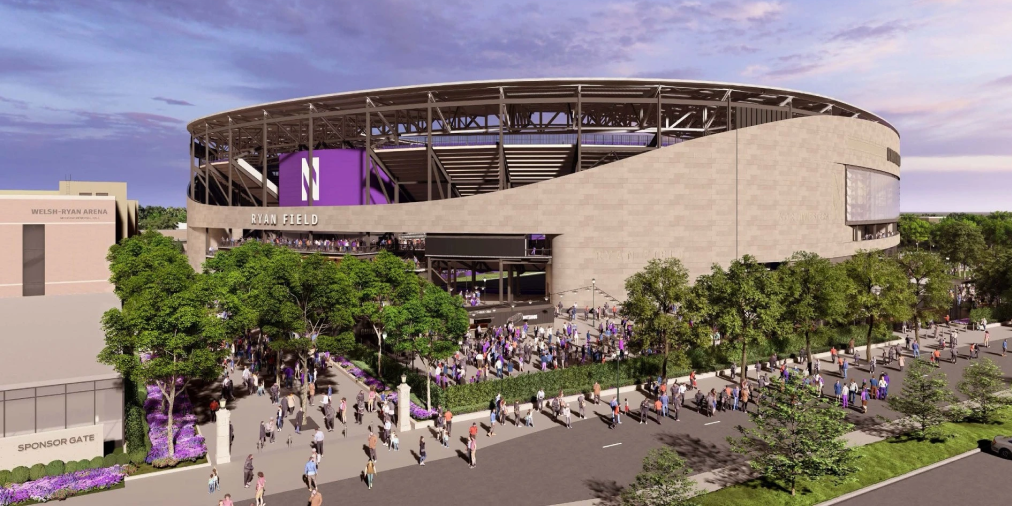
Northwestern is replacing a 47,000-seat stadium built in 1926 with a 35,000-seat one that costs $862 million. On paper that makes no sense. Fewer seats, more money than any college stadium has ever cost. Until you understand what the new Ryan Field is actually built to do.
The capacity drops 30% but the building gets 78% larger, with the added space going to club areas, plazas, and premium experiences rather than bleacher seats. About 10% of the seats sit in premium sections, and those sections are projected to generate 40 to 50% of football revenue. Four indoor club areas double as year-round event spaces. The 200,000 square feet of surrounding plazas become ticketed space on game days and rentable venue space the rest of the year.
The whole thing is privately funded by the Ryan family, who own a stake in the Chicago Bears and the Premier League’s AFC Bournemouth, and studied MLS and English soccer venues rather than other college stadiums during the design.
Pat Ryan Jr. was explicit about the premium pricing philosophy: “Why subsidize the rich? If you're in the Chicago business community doing corporate entertainment, you should pay the appropriate price.”
Beyond football, the stadium is approved to host six concerts a year starting in 2027, holiday festivals, and major NCAA championship events. Northwestern is even pursuing youth and high school sports as a deliberate “second anchor tenant” strategy to keep the venue active and generating revenue on days the Wildcats aren’t playing.
The takeaway: A smaller stadium can generate more money than a bigger one if you design every square foot around revenue per attendee instead of total attendance. Northwestern built the clearest example of that principle in the country.

USF’s $407 million on-campus stadium doesn’t open until September 2027, but the most valuable inventory in the building is already gone. All 28 luxury suites sold out before premium seating even went on public sale.
Athletics CEO Rob Higgins put the demand plainly: “The demand around the stadium’s premium offerings has been incredible without even officially being on public sale yet.”
The lesson for other programs isn’t just that USF sold suites. It’s how they structured the premium tiers to capture demand at every level above a standard ticket. Beyond the 28 suites, the stadium offers 22 living room boxes with lounge seating and personal video screens, 17 loge boxes, and roughly 2,200 club seats across three distinct club experiences, each with its own identity.
There’s the Ninety-Seven Club, all-inclusive midfield seats with access to a hidden speakeasy lounge built into the stadium. There’s the Sideline Club and the Field Club, each with dedicated lounges. Every premium seat includes all-inclusive food, beer, and wine, plus priority access to non-USF stadium events like concerts.
USF also tied premium seat selection to Bulls Club giving level and lifetime donation totals, which means the premium inventory doubles as a fundraising engine: the more you give, the better your access. Meanwhile general season tickets start as low as $25 a game, keeping the building accessible while the premium tiers do the revenue work.
A mid-major program in the American Conference built a premium revenue ladder sophisticated enough to sell out its highest tier two years early.
The takeaway: Premium demand exists at every level of college athletics, not just the blue bloods. USF proved it by selling out its suites before the public could even buy them. The programs that build the right premium ladder capture revenue the programs selling only standard tickets leave on the table.

Most athletic directors treat the schedule as a logistical puzzle. West Virginia AD Wren Baker treats it as a revenue lever.
The clearest example: WVU bought its way out of a road game at East Carolina and replaced it with a neutral-site game against Virginia at Bank of America Stadium in Charlotte.
Under the agreement with Charlotte Sports Events for the 2026 and 2032 matchups, both WVU and Virginia are guaranteed the greater of a $2 million payout or 45% of net revenue per game, meaning each school walks away with no less than $4 million across the two contests. A road game at East Carolina generated nothing close to that.
Baker has been deliberate about which games to convert and why. His rule is a non-negotiable floor of at least six, ideally seven, home games in Morgantown each season to protect the home gate and the local economy. Above that floor, neutral-site games become a tool he deploys when the financials, the opponent, and the location align. Charlotte specifically, where WVU has a dense population of alumni and fans who left the state, has become a target market the program is intentionally planting its flag in.
The strategy extends to basketball, where neutral-site games in Charlotte and Greensboro serve double duty by improving NET and RPI metrics while engaging fans in growth markets. Baker frames the whole approach around what he calls “revenue buckets,” treating licensing, ticketing, scheduling, and media as distinct levers to be individually optimized rather than a single budget to be managed.
The takeaway: The schedule is one of the few revenue assets an athletic director controls directly every single year. Most programs leave that value untapped. West Virginia turned a single road game into a guaranteed $4 million by treating scheduling as a commercial decision, not just a competitive one.

For more than a decade, Wake Forest owned roughly 100 acres of mostly vacant land sitting between its football stadium and the Joel Coliseum, and for more than a decade it generated almost nothing.
AD John Currie and university leadership are turning that dead space into The Grounds, a $150 million mixed-use development designed to convert event-day-only land into a 365-day commercial hub. The development is built around the same model as The Battery in Atlanta, the Braves’ mixed-use district, and is being designed by the same architecture firm.
Phase one includes a 40,000-square-foot retail village with chef-driven restaurants and boutique shops, loft-style residential units above the retail, a 100,000-square-foot office building that Wake Forest itself is anchoring as a tenant, and a 240-unit residential community. The office and retail are targeted for completion by summer 2026, the residential by 2027.
The economics work on multiple levels. Wake Forest secured a $35 million state grant for infrastructure, roads, and a restored creek with walking trails, meaning public money funded the groundwork that makes the private development viable. The area already hosts more than 750,000 patrons across 260-plus event days a year between Wake athletics, the Carolina Classic Fair, concerts, and the Winston-Salem Open tennis tournament.
The Grounds captures that existing foot traffic and gives it somewhere to spend money before and after events, while the residential and office tenants generate revenue independent of any event at all. As the project leadership put it, the goal is to move 100 acres “from event day use to 365 days a year use.”
The takeaway: Underutilized land near a venue is a revenue asset waiting to be activated. Wake Forest took dead parking lots that generated nothing and is turning them into a branded district that earns money whether or not a game is being played. The land was always there. The vision to develop it is the strategy.
The programs featured here aren't creating revenue through entirely new ideas. They're generating more value from assets they've owned for years.
A stadium becomes a year-round entertainment venue. Premium seating becomes a recurring revenue engine. Parking lots become mixed-use developments. Scheduling becomes a commercial strategy instead of an operational task.
The common thread is simple: the schools creating long-term financial advantages aren't just managing athletic departments, they're managing portfolios of commercial assets.
As college athletics revenue strategies continue to evolve, the greatest opportunities may not come from building something new, but from unlocking the full value of what's already there.