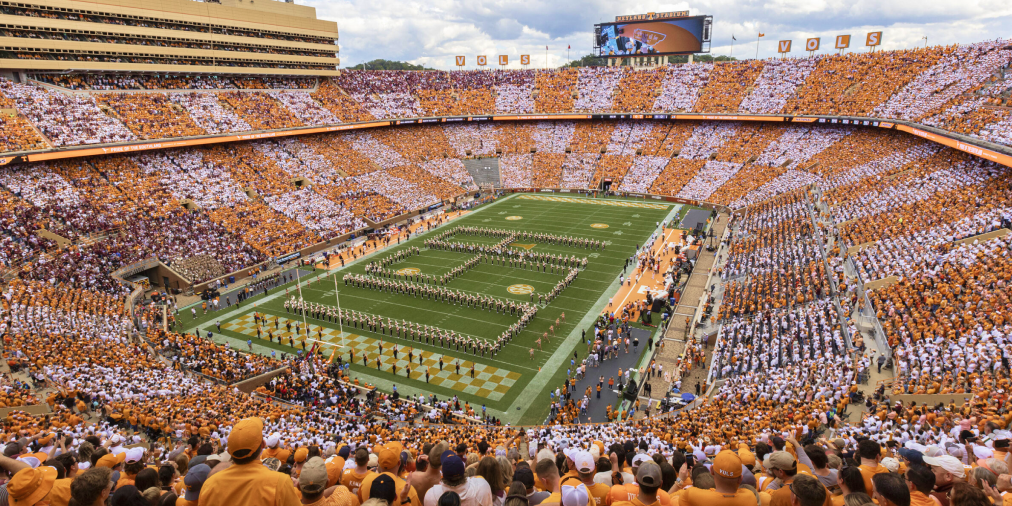
College athletics has entered a new financial era. Revenue sharing is mandatory, roster costs are climbing, and donor contributions alone won't close the gap.
The programs pulling ahead aren't waiting for a legislative fix or a major donor to show up. They're building commercial infrastructure. They're monetizing assets they already own. They're treating the athletic department like a business.
From premium fan experiences and year-round venue monetization to subscription-based revenue and new operating structures, universities are finding innovative ways to create recurring income.
We break down four strategies worth stealing.

The University of Oklahoma created the Sooner Magic Memories program to do something deceptively simple: monetize the access that already exists inside a major college football program.
For years, programs treated behind-the-scenes moments, the locker room, the field, the press conference, as exclusive territory. Oklahoma flipped that assumption and put a price on it.
Through Sooner Magic Memories, fans can purchase pregame photos on the 50-yard line, a seat in Coach Brent Venables' postgame press conference alongside working media, a spot in the high-five tunnel, game ball delivery, and a ride on the historic Red Rocket Model T during the Walk of Champions. Pricing scales with the opponent.
The season opener against Illinois State was priced at $462 for two people and sold out in a single day. The Michigan game went for $692. Arizona has since launched a similar press conference pass at $150 per person, and the model is spreading.
What makes this strategy powerful isn't the revenue per transaction. It's the logic behind it. Oklahoma didn't build anything new. They didn't negotiate a new media deal or launch a capital campaign. They identified inventory that was sitting right in front of them, access to moments fans already cared deeply about, and created a mechanism to sell it.
Every athletic department in the country has a version of this inventory. Most of them are giving it away for free.
The takeaway: The most valuable inventory in college sports isn't always in the stadium. It's the access around it, and most programs haven't touched it.
Tennessee made a decision that sounds obvious in hindsight but most programs haven't had the nerve to act on: stop treating a 101,915-seat venue as a football facility that goes dark for ten months a year.
Neyland Stadium is now a live events destination that operates year-round. Morgan Wallen drew over 160,000 fans across two sold-out nights. Luke Combs followed in May 2026 as part of a six-stadium college venue tour. Every concert generates ticket revenue, premium seating revenue, and concessions from a facility the department is already paying to maintain regardless of whether anyone is in it.
AD Danny White has been direct about the strategy: "Whenever we have a landmark venue like Neyland Stadium, we will continue to seek opportunities to host events on Rocky Top, beyond just football game days."
The concert revenue pairs with a 20-year naming rights deal with Knoxville-based Pilot and a $5 million investment in new premium club seating at the Food City Center already projected to generate $7 million annually.
None of this is complicated. It's the application of a basic commercial principle: if you own a valuable asset, make it earn. Tennessee's total athletics revenue hit $304 million in fiscal year 2024-25, the highest in school history and a $70 million increase over the prior year. The venue strategy is a meaningful piece of that number.
The takeaway: A stadium is only worth what you're willing to do with it. Tennessee stopped treating Neyland as a football venue and started treating it as the most valuable piece of commercial real estate in the state.
Boise State launched Bronco Mobile, a co-branded wireless phone plan built on T-Mobile's network through Collegiate Mobile and Learfield. And in doing so, created something most athletic departments haven't figured out how to build: a revenue stream that requires no game day, no event, and no donation ask.
The model is straightforward. Fans, students, and faculty sign up for plans ranging from $15 to $45 per month. A portion of every monthly bill goes directly to Boise State athletics or a designated scholarship fund of the subscriber's choosing, including the Athletic Director's Excellence Fund or the True Blue Endowed Scholarship.
Subscribers keep their existing phones and phone numbers. There's no contract and no extra cost beyond the plan itself. The revenue compounds automatically with every new subscriber, every single month, regardless of what's happening on the field.
To drive sign-ups, Bronco Mobile layers in real fan value: game day VIP experiences, surprise seat upgrades at Albertsons Stadium and ExtraMile Arena, and exclusive giveaways including pregame hospitality passes and signed gear.
It's a fan engagement program and a revenue mechanism built into the same product. The genius of the model is that it converts an existing monthly expense, a phone bill that fans were already paying somewhere else, into direct support for the program.
Boise State's AD Jeramiah Dickey put it plainly: "Everything counts, everything matters." Collegiate Mobile CEO Joe Phillips framed it structurally: "The tectonic shift in economics for collegiate athletics means athletic departments need to get creative to remain competitive, and Bronco Mobile is a new way to support the team on and off the field."
The takeaway: Fans are already spending money every month on things that have nothing to do with their favorite program. Bronco Mobile redirects a portion of that spending automatically. That's a model any school can replicate.
Virginia Tech's Board of Visitors votes June 1 on a proposal that could become the most significant structural decision in the program's history. The plan: create Hokie Ventures LLC, a nonprofit limited liability company that separates the commercial operations of Virginia Tech Athletics from the athletic department entirely.
Under the new structure, the athletic director keeps traditional responsibilities, coaches, student-athletes, and day-to-day operations. A newly hired CEO takes over everything commercial: sponsorships, multimedia rights, naming rights, and donor engagement. Hokie Ventures will be governed by an independent board, not the university, giving it the operational flexibility to move like a business rather than a public institution.
Virginia Tech is capitalizing it with $15.2 million from the $229.2 million "Invest to Win" plan approved last fall. The plan also builds in the option to convert to a for-profit structure down the road, creating a pathway to attract private capital and manage NIL at a scale that a traditional athletic department structure can't support.
The person presenting the plan to the board is Brandon Hall, Virginia Tech's athletics CFO, who served as Clemson's CFO when Clemson Ventures launched in August 2024. He didn't just study the model. He helped build it, and he brought the blueprint to Blacksburg. Virginia Tech isn't alone. Clemson, Kentucky, Michigan State, and Texas Tech have all moved in this direction.
The separation of commercial operations from athletic department oversight is becoming the standard structure for programs that want to compete commercially in the post-House era.
What makes Virginia Tech's case particularly notable is the timing. The school is simultaneously searching for a new AD, a new university president, and a new Hokie Club director. Rather than waiting for stability to pursue structural change, they're using the reset as the moment to build something new from the ground up.
The takeaway: The athletic director of the future has two jobs: run the program and run a business. Virginia Tech, Clemson, and others have decided those two jobs are better handled by two different people.
While the tactics differ, each university is solving the same problem: creating new revenue without relying solely on donor contributions or conference distributions.
Common themes include:
As college athletics enters the revenue-sharing era, the departments that build commercial infrastructure today will likely have a competitive advantage tomorrow.
NOCAP helps university athletic departments activate alumni businesses, commercial partnerships, and existing relationships to create recurring revenue that supports long-term athletic success.
Contact us today to learn more.